Free app · October 27, 2026 · Runs in your browser
Discount Break-Even Calculator
A 20% discount on a 60% margin wine needs 50% more bottles just to earn what a normal week earns. On a 40% margin it needs double. Type in your own numbers and see what the sale you are planning really has to sell, then compare it with offers that cost you less. For wineries, breweries, distilleries, and shops.
- Stays on your computer. Your numbers are read and worked out by your browser. No upload exists.
- Never put into Claude or any AI. No AI model reads your numbers. The arithmetic runs as plain code on your machine.
- We never see, store, or use them. Nothing to keep, train on, or sell. Close the tab and they are gone.
Step 1
Your numbers.
Four numbers you already know. Change any of them and the answer updates. Nothing is sent anywhere.
Optional: orders, your list, shipping
Step 2
20% off a $30 bottle that costs you $12 needs 50% more bottles just to match a normal period: 450 instead of 300, so 150 extra.
+50%
more bottles, just to break even
150
extra bottles on top of 300
$12.00
a bottle on sale, down from $18.00
At 3 bottles an order that is 50 extra orders. Every one of those orders has to come from the sale itself: a customer who would have paid full price anyway does not count, they just paid you less.
What if the sale works?
Profit during the 20% sale at a few guesses for the lift, against $5,400 in a normal period.
- +10%330 bottles$3,960$1,440 behind
- +25%375 bottles$4,500$900 behind
- +50%450 bottles$5,400breaks even
- +100%600 bottles$7,200$1,800 ahead
Every discount, same question
How many extra bottles each discount needs with your price and cost. Your discount is highlighted.
| Discount | Sale price | Margin a bottle | Lift needed | Extra bottles |
|---|---|---|---|---|
| 5% | $28.50 | $16.50 | +9% | 28 |
| 10% | $27.00 | $15.00 | +20% | 60 |
| 15% | $25.50 | $13.50 | +33% | 100 |
| 20% | $24.00 | $12.00 | +50% | 150 |
| 25% | $22.50 | $10.50 | +71% | 215 |
| 30% | $21.00 | $9.00 | +100% | 300 |
| 40% | $18.00 | $6.00 | +200% | 600 |
Cheaper ways to say sale
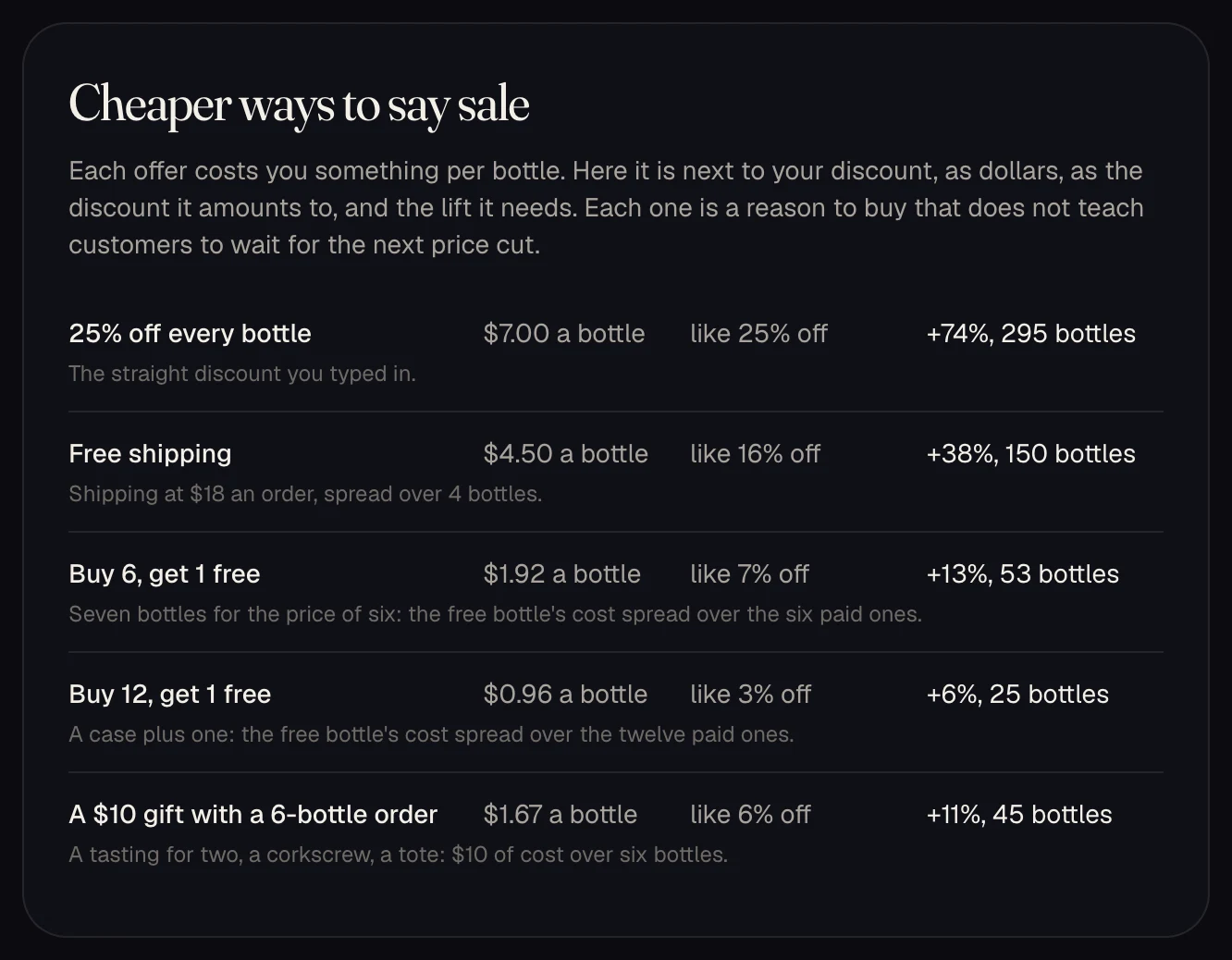
Each offer costs you something per bottle. Here it is next to your discount, as dollars, as the discount it amounts to, and the lift it needs. Each one is a reason to buy that does not teach customers to wait for the next price cut.
- 20% off every bottle$6.00 a bottlelike 20% off+50%, 150 bottles
The straight discount you typed in.
- Free shipping$5.00 a bottlelike 17% off+38%, 116 bottles
Shipping at $15 an order, spread over 3 bottles.
- Buy 6, get 1 free$2.00 a bottlelike 7% off+13%, 38 bottles
Seven bottles for the price of six: the free bottle's cost spread over the six paid ones.
- Buy 12, get 1 free$1.00 a bottlelike 3% off+6%, 18 bottles
A case plus one: the free bottle's cost spread over the twelve paid ones.
- A $10 gift with a 6-bottle order$1.67 a bottlelike 6% off+10%, 31 bottles
A tasting for two, a corkscrew, a tote: $10 of cost over six bottles.
Want the tables as a spreadsheet?
Subscribe free and the download opens. You also get the newsletter three mornings a week and the 50-prompt AI Playbook. Your numbers still never leave this page.
Step by step
How to use it
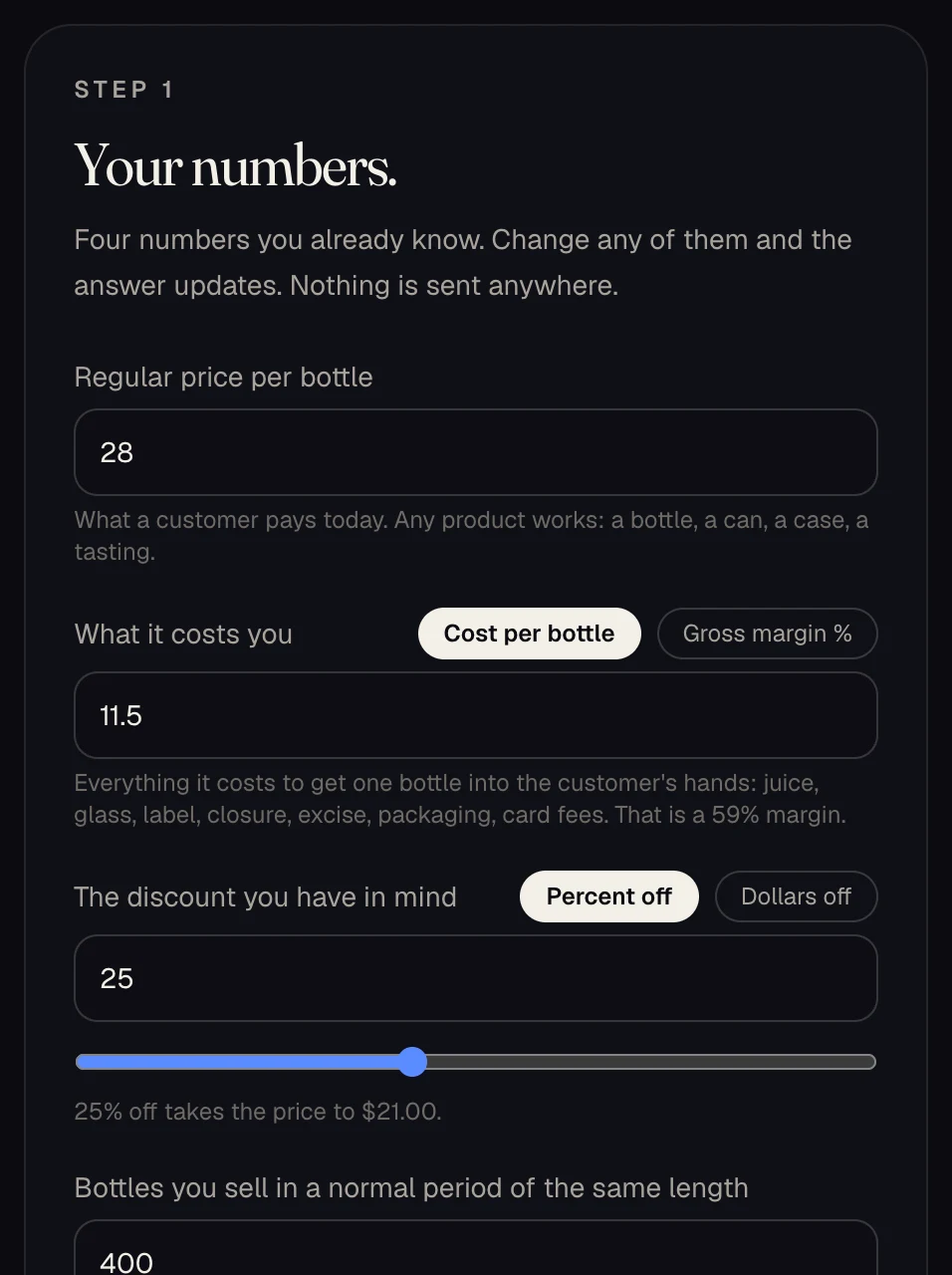
The pictures below are a made-up winery planning 25% off a $28 bottle. Type your own numbers and yours appear the same way.
Type in four numbers.
Your price, your cost (or your margin), the discount you have in mind, and what you sell in a normal period the same length as the sale. Here: a $28 bottle that costs $11.50, 25% off, and 400 bottles in a normal two weeks.
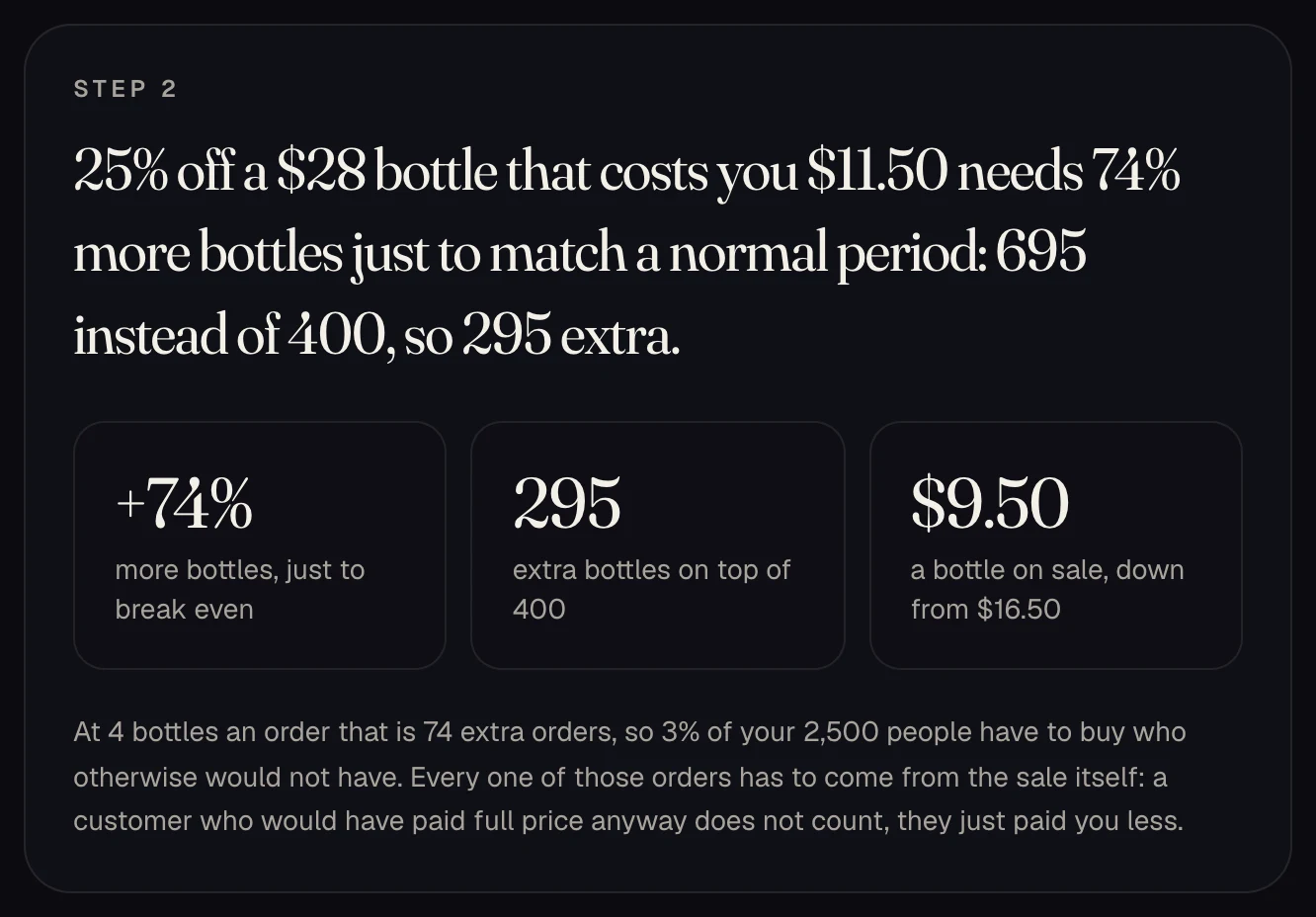
Read the answer at the top.
One sentence tells you how many more bottles the sale has to move just to match a normal period. In the example it's 74% more, 295 extra bottles, because the margin on each bottle drops from $16.50 to $9.50.
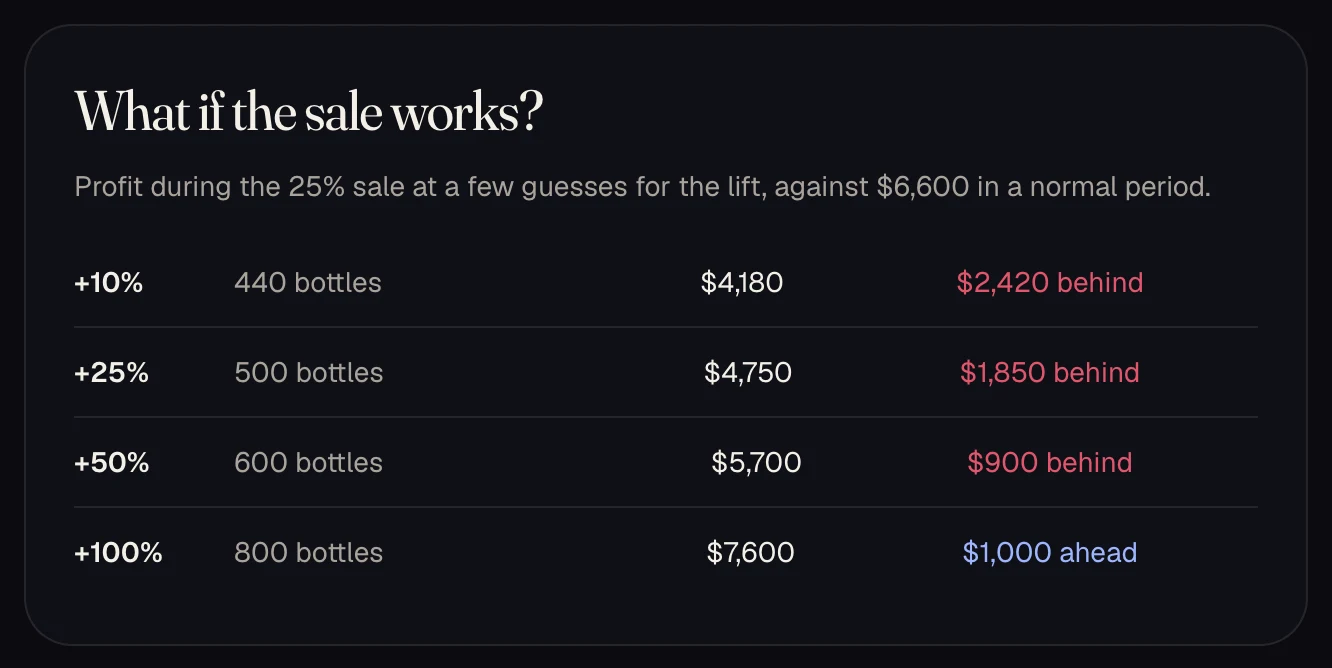
See what happens if the sale works.
Profit at four guesses for how well it goes, against a normal period. The example sale is still $900 behind with 50% more bottles.
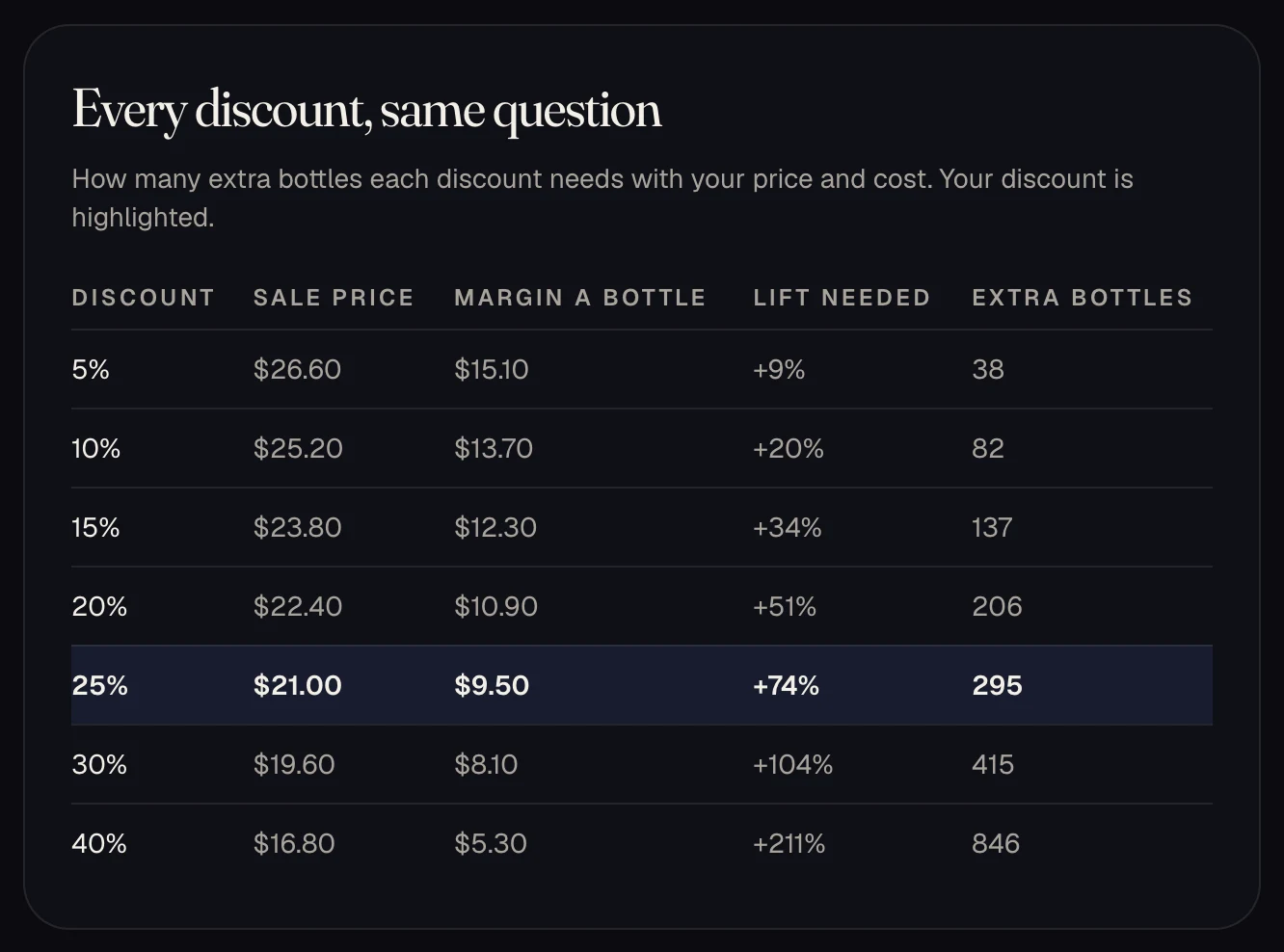
Compare every discount.
The same question for every discount from 5% to 40%, with yours highlighted, so you can see where a smaller cut stops costing you.
Price the cheaper offers.
Free shipping, buy 6 get 1, buy 12 get 1, and a gift with purchase, each as what it costs you per bottle. In the example, buy 12 get 1 costs $0.96 a bottle against $7.00 for the discount. Copy the Claude prompt to design the offer, or subscribe free to download the tables.
How the math works
A sale changes two things at once: more bottles go out, and every one of them earns less. The calculator starts from what a normal period earns (bottles sold times margin per bottle) and asks how many bottles the sale has to move at the thinner margin to earn the same dollars. That extra share is the lift needed, and it is always bigger than people guess, because the discount comes out of the margin, not out of the price.
The rule of thumb underneath: lift needed is the discount divided by (margin share minus discount). A 20% discount on a 50% margin is 20 over 30, so 67% more bottles. The same discount on a 70% margin is 20 over 50, so 40%. And once the discount reaches the margin share, no number of extra bottles gets you back to even.
It assumes every bottle sold during the sale gets the discount, including the ones that would have sold anyway. That is how a storewide or list-wide sale behaves. An offer that only reaches new buyers (a first-order code, a trade-show special) is a better deal than this page shows, which is one more reason to aim offers instead of cutting the price for everyone.
What to put in for cost
Everything it costs to get one bottle into the customer's hands: juice or liquid, glass, label, closure, excise, packaging, and card fees. Leave out rent, salaries, and marketing, which you pay whether the sale runs or not. If you only know your gross margin, switch the cost field and enter that instead. For a shop, cost is what you paid the distributor plus freight. For a brewery, use the cost of a case or a four-pack and sell in those units.
Before you cut the price
The comparison in the results puts your discount next to free shipping, buy 6 get 1, buy 12 get 1, and a gift with purchase, each as what it costs you per bottle and the lift it needs. A gift that costs $10 on a six-bottle order is $1.67 a bottle, which on a $30 bottle is under 6% off, and it reads as generous rather than desperate. Customers who get a price cut learn to wait for the next one. Customers who get a bundle, a release, or something in the box learn that buying is worth it.
Your data, in plain words
This one takes a few numbers rather than a file, so there is even less to worry about. The same promise covers every app on this site, question by question, and every answer is checked against the code that runs the page.
- What do I give the app?
- Four numbers: your price, your cost (or margin), the discount you are thinking about, and how many bottles you sell in a normal period. Three more if you want them: bottles per order, your list size, and what shipping costs you. No file, no names, no account. Type them in and the page does the arithmetic on your computer.
- Is my data put into Claude or any other AI?
- No. Never. The scoring is a fixed list of rules, written out on each app's page, and your browser runs them as ordinary code. No AI model, Claude or otherwise, reads your file, your names, or your numbers. The only time Claude comes up is if you choose to click a Copy button that writes a prompt for you. That prompt holds your group counts and a dollar figure, never a name or an email, and it goes to your clipboard, not to us. What you paste into Claude after that is between you and your own Claude account.
- Where does the file go?
- Nowhere. Your browser opens it with its own built-in file reader, the scoring runs as JavaScript on your computer, and the results are drawn on your screen. There is no upload button because there is no upload. These pages have no server address that accepts member data at all. The spreadsheet download is built in your browser too.
- Can you see it?
- No. Not the file, not the names, not the scores, not even that you ran one. The only thing our server ever receives from an app that works on your data is an email address, and only if you type one into the subscribe box. Our visitor counter (Cloudflare Web Analytics, no cookies) records that a page was opened and what kind of browser opened it. It cannot see the contents of the page or the file.
- Do you store it or use it?
- We cannot store or use what never reaches us. There is no copy on our side to train on, sell, benchmark, or look at. Close the tab and it is gone from your browser as well. The one thing a page remembers is a yes/no flag that you already subscribed, so the download stays open next time.
- How can I check for myself?
- Load the page, turn off your Wi-Fi, then drop in your file. It still works, because it never needed a connection. Or open your browser's developer tools on the Network tab and watch while you drop the file: no request leaves with your data. Cautious to the end? Delete the name and email columns before you export. The list will read Row 12, Row 13, and the score is just as good.
Questions this does not answer? Reply to any issue of the newsletter and ask. It goes straight to Jeremy.
Build your own
Want your own offers in the comparison, a version in your currency, or one that lives on your laptop? Paste this into Claude and it builds you a copy. Then describe the promotions you usually run and it adds them to the table.
Build me a single-page web app in one HTML file, no server and no libraries, called Discount Break-Even Calculator.

Inputs: regular price per bottle, cost per bottle (with a switch to enter gross margin percent instead), the discount (percent off, with a switch for dollars off, plus a slider), bottles sold in a normal period of the same length as the sale, and optional fields for average bottles per order, email list size, and what free shipping costs per order.

The model: during the sale every bottle sells at the discounted price, including the ones that would have sold at full price. Margin per bottle is price minus cost. Sale margin is the sale price minus cost. The lift needed is margin divided by sale margin, minus one (the same as discount divided by margin share minus discount). If the sale margin is zero or less, say the sale can never break even.

Show: a one-sentence verdict with the numbers filled in; three tiles (lift needed as a percent, extra bottles, margin per bottle on sale versus normal); the extra orders that lift means and what share of the list has to place one; a what-if table of profit at 10, 25, 50, and 100 percent lift against a normal period; a table of every discount from 5 to 40 percent with the sale price, margin, lift, and extra bottles, with mine highlighted; and a comparison of cheaper offers (free shipping, buy 6 get 1, buy 12 get 1, a $10 gift with a 6-bottle order) showing each one's cost per bottle, the discount it amounts to, and the lift it needs. Add a Download CSV button. Everything runs in the browser and nothing is sent anywhere.

Then add my own offers to the comparison: [DESCRIBE THE OFFERS YOU USUALLY RUN, OR ASK ME].

Work with Jeremy
Want a better offer than a discount?
Book a 30-minute strategy session and we'll work out an offer that moves bottles without giving away your margin.
30 minutes on Google Meet