Why the "Dumb Questions" are your next marketing goldmine
Plus, try this social media hack and a look at the math the industry has been avoiding
 Jeremy Young5 min read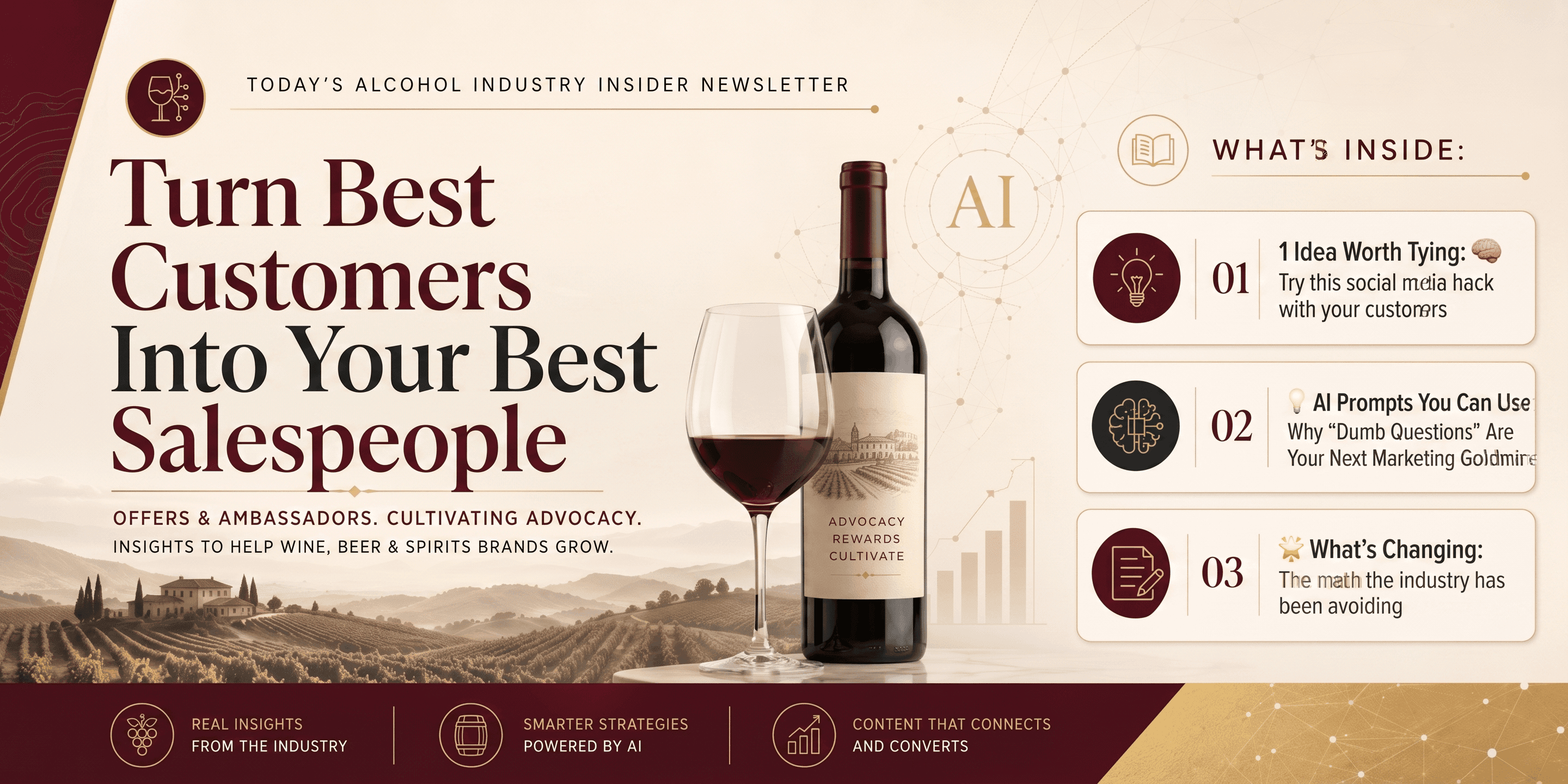
Today’s Alcohol Industry Insider Newsletter
What’s inside:
🧠 1 Idea Worth Trying: Try this social media hack with your customers
💡 AI Prompts You Can Use: Why the "Dumb Questions" Are Your Next Marketing Goldmine
🌟 What’s Changing: The math the industry has been avoiding
A quick word before we get started. Last week's issue didn't go out. We had a family situation down in Arizona that needed us, and the newsletter had to wait. The plan moving forward is two issues a week. Some weeks it might be one, depending on what's on my plate, but I'll always aim for two.
One ask. If you've been getting value from this, please forward it to someone in the industry who would too. That single forward does more than you'd think, and I genuinely appreciate every one of them.

Turn Your Best Customers Into Your Best Salespeople (For the Cost of a Discount)
Most wineries spend the bulk of their marketing budget trying to convince strangers to care. Meanwhile, the people who already love you are sitting on the most valuable asset in your business: their friends.
Here's a campaign you can launch this week. No agency. No new tech stack. Just an email or text to your existing customer list.
The Offer
Send your current customers a 50% discount on a 3-pack or 6-pack. In exchange, they agree to host a wine night for friends. Small group, casual setting, maybe a few simple food pairings.
The catch is they have to do five things within 30 days:
Invite friends over for a wine night. Make it feel like an event, not a sales pitch.
Walk those friends through each bottle. Tell the story behind the winery, the vintage, the people.
Post photos and short videos on social media and tag the winery.
Have their friends follow the winery's social accounts.
If any of those friends sign up for the wine club, the host gets a special thank-you gift (doesn’t have to be anything big)
Why This Works
Trials happen in living rooms, not tasting rooms. Most new wine drinkers will never visit your property, never click your ad, and never open a cold email. But they will absolutely try something new when a trusted friend hands them a glass and tells them why it matters.
You're solving the hardest problem in wine right now, which is introducing the category to people who currently default to cocktails, beer, hard seltzer, or anything else. You're doing it in the most credible environment possible (a friend's home), with the most credible salesperson possible (the friend themselves).
The user-generated content is a bonus. Every post becomes a piece of social proof you can repost, reuse in paid ads, or send to your distributor as proof of demand.
Run the Math
If you send this offer to 500 customers and 10% participate, that's 50 wine nights. If each host averages 4 guests, you've put your wine in front of 200 new people in a single month. Even a 5% wine club conversion rate on those guests is 10 new members from a campaign that costs you nothing but margin on the discounted packs.
That's better economics than almost any paid acquisition channel you're running right now.
Pick a month. Send the text and emails. See what happens.

Walk into almost any tasting room, brewery taproom, or distillery bar, and you'll hear the same thing: a guest leans in, lowers their voice, and asks the somm or bartender something they're embarrassed to say.
"Why does red wine give me a headache?" "Is it weird that I like this stout warm?" "What's the difference between bourbon and whiskey, actually?"
Here's the secret most operators are missing. Those questions are not friction. They are the entire content strategy you've been looking for.
Modern drinkers are actively rejecting stuffy gatekeeping. They want real answers from real people, delivered without the swirl-and-spit theater. The brands winning attention right now are the ones treating beginner questions as a gift rather than a nuisance.
The Move
Pull out a phone. Film your team answering the questions guests are too shy to ask. Post them as short-form video on TikTok and Reels under a recurring series. Something like:
"The Dumb Questions People Ask Us (That Are Actually Genius)"
Each video runs 30 to 60 seconds. One question. One honest answer. No script polish, no jargon, no cork-sniffing. Just your sommelier, brewer, or distiller being a human.
Why It Works
Demystifying the liquid does three things at once:
Builds trust faster than any tasting note ever could
Pulls in casual scrollers who would never visit your website
Converts those viewers into DTC buyers because they already feel like insiders
The wineries, breweries, and distilleries that figure this out in 2026 will own the algorithm. The ones still posting drone shots of vineyards at golden hour will keep wondering why their reach is collapsing.
Start with the questions you secretly roll your eyes at. Those are the ones the internet wants answers to.
3 Claude Prompts to Get Started
Copy and paste these straight into Claude Chat and customize the bracketed sections.
Prompt 1: Generate the Question List
You are a content strategist for a [winery / brewery / distillery] in [region].
I want to launch a short-form video series called "The Dumb Questions People
Ask Us (That Are Actually Genius)."
Give me 30 specific questions real consumers ask about [wine / beer / spirits]
that would make great 30 to 60 second video topics. Organize them into four
buckets:
1. Tasting and serving (temperature, glassware, decanting)
2. Health and body (headaches, sulfites, hangovers, calories)
3. Pairing and occasion (what to drink with what, gift-giving, seasonality)
4. Production and origin (how it's made, what the label means, regional differences)
For each question, add one sentence on why it would perform well on TikTok
or Reels. Skip anything that requires a sommelier-level answer. Prioritize
questions a curious 28-year-old would actually ask their phone.
Prompt 2: Write the Video Scripts
Write five 45-second video scripts for our short-form series. Our brand is
[brand name], a [winery / brewery / distillery] in [region], and our voice
is [warm, irreverent, plainspoken, etc.]. The host is [name and role].
Each script should:
- Open with a hook in the first 3 seconds that stops the scroll
- State the question clearly on screen and out loud
- Deliver the answer in plain language with one specific, surprising detail
- End with a soft CTA that invites engagement rather than a hard sell
Format each script with three columns: timestamp, what the host says, what
appears on screen as text overlay. No corporate filler. Write the way the
host actually talks. The five questions to cover are:
1. [Question 1]
2. [Question 2]
3. [Question 3]
4. [Question 4]
5. [Question 5]
Prompt 3: Build the Production and Posting Framework
Act as a short-form video producer who has scaled multiple beverage brand
TikTok accounts past 100K followers. Build me a complete production and
posting framework for a weekly series called "The Dumb Questions People
Ask Us (That Are Actually Genius)."
Deliver the following:
1. A repeatable shot list and setup that one person can film in under
30 minutes per video
2. The visual identity rules (text overlay style, captions, intro and
outro treatment, music direction)
3. A weekly batch-filming workflow so we can shoot a month of content in
one afternoon
4. Posting cadence and platform-specific guidance for TikTok, Reels,
and YouTube Shorts
5. The first 12 video titles in order, designed to build a binge-able
playlist for new viewers
6. The three KPIs to track in the first 90 days and what good looks like
for a beverage brand of our size
Our team is [size] and our budget for production is [amount]. Be
specific and skip the generic advice.

The Wine Industry's Real Problem Isn't Price. It's the Funnel.
Damien Wilson, the new Faculty Director of the Wine Business Institute at Sonoma State, lays out a three-step turnaround framework for U.S. wine brands rooted in marketing science rather than gut instinct. His core argument: the industry is five years into a structural contraction, not a cyclical dip, and the typical reflexes (discounting, price hikes disguised as premiumization, doubling down on existing wine club members) are accelerating the bleed.
The three steps
Acknowledge the real scale of the contraction. The 30-year run of organic growth ended in 2021. DtC volumes dropped 10% YoY the following year and have kept falling. U.S. wine production has fallen from roughly 900 million gallons in 2017 to just over 700 million in 2025, a 20%+ contraction touching nearly every price point and producer size.
Reject the "premiumization mirage." Raising prices has correlated directly with consumer loss since 2021. Sovos ShipCompliant's 2026 report shows DtC went from 8.7M cases at a $38 average bottle price in 2020 to just 5.3M cases at $57. The luxury-asset defense also collapses under Jon Moromarco's 2025 BW166 data, which shows volume declines in every grape price tier above $1,500/ton, including a 10% drop in the $10,000+/ton ultra-premium tier.
Customize appeal to win new customers. Five out of six brands grow through net customer acquisition, not CRM. The post-pandemic spike in loyalty was an artifact of restaurants being closed, and churn has since reverted to historical norms. Inflated prices have built an entry barrier that's now blocking the next generation of drinkers.
Producer count made the math worse: roughly 8,000 wineries in 2015 grew to over 12,000 by 2023 while total production shrank. More producers chasing a smaller, older, wealthier pool.
Risks for operators who ignore this
Discount death spiral. Reflexive price cuts to recover volume train the market to wait for the next sale and erode brand equity at the same time.
CRM over-investment. Pouring budget into wine club retention while ignoring top-of-funnel guarantees a slow bleed as natural attrition outpaces a frozen acquisition engine.
Premiumization lock-in. Brands that have rebuilt their P&L assumptions around $50+ bottles have no easy path back down. Cost structure, packaging, and distributor relationships all calcify around the higher price.
Demographic cliff. Without an entry-level offer, there's no funnel feeding the next generation of buyers. Today's club retention masks tomorrow's acquisition failure.
Distributor de-prioritization. Shrinking case volumes combined with rising shelf prices make wineries less attractive to wholesalers already consolidating their books.
Opportunities for forward-thinking brands
Build a real acquisition engine. Most wineries don't have one. Even basic paid social, lookalike audiences, and pixel-based retargeting put a winery ahead of 80% of competitors who are still relying on tasting room foot traffic and email blasts to existing buyers.
Re-introduce an accessible price tier. A well-positioned $20 to $30 SKU under a sub-brand or second label can lower the entry barrier without compromising the flagship's positioning.
Treat tasting rooms as acquisition channels, not transaction venues. Conversion rate from walk-in to club is the metric that matters. Most wineries don't even track it.
Lean into data infrastructure. GA4, server-side conversions, Commerce7, Klaviyo flows, and a unified attribution view turn marketing from opinion to math. The few who do this win share from the many who don't.
Win the on-premise comeback. With BTG programs rebuilding, the wineries that show up with sales reps, training materials, and accessible price points will own placements for years.
Court the curious, not just the credentialed. Producers who modernize tone, drop the gatekeeping, and meet new drinkers where they actually are (TikTok, Instagram, RedChirp-style texting) can take meaningful share from the wineries still printing six-page tasting notes.
Reposition the brand story around relevance, not heritage. Heritage matters to existing buyers. Relevance is what brings new ones in.
None of this is theoretical. The data is loud, the playbook exists, and a handful of producers are already executing on it quietly while the rest of the industry debates whether the slump is real. The question isn't whether the market will reward wineries that modernize their acquisition, pricing, and brand strategy. It already is. The only question is whether you'll be one of them.
From the Editor:
I am always open to consulting, implementation, or brainstorming sessions. Just respond to this email, and I will get back to you shortly.
Alcohol Industry Insider Newsletter - The twice-a-week growth newsletter for wine, beer, and spirits businesses that need smarter marketing, better sales, practical AI tools, and clear ideas they can implement now.
By Jeremy Young - serial entrepreneur, growth marketer, wine critic, and beverage industry insider.
Respond to this email with questions, ideas, or opportunities, and I will get back to you shortly!
Until next time,
— Jeremy
Share This Newsletter
If you found this content useful, please share it with your colleagues and friends…
👉 www.alcoholindustryinsider.com
Get the next one in your inbox.
Free, mondays, wednesdays, and fridays. Five minutes to read.