7 Decision Frameworks built by the masters of business
Plus, before wine club members leave, they tell you why...
 Jeremy Young5 min read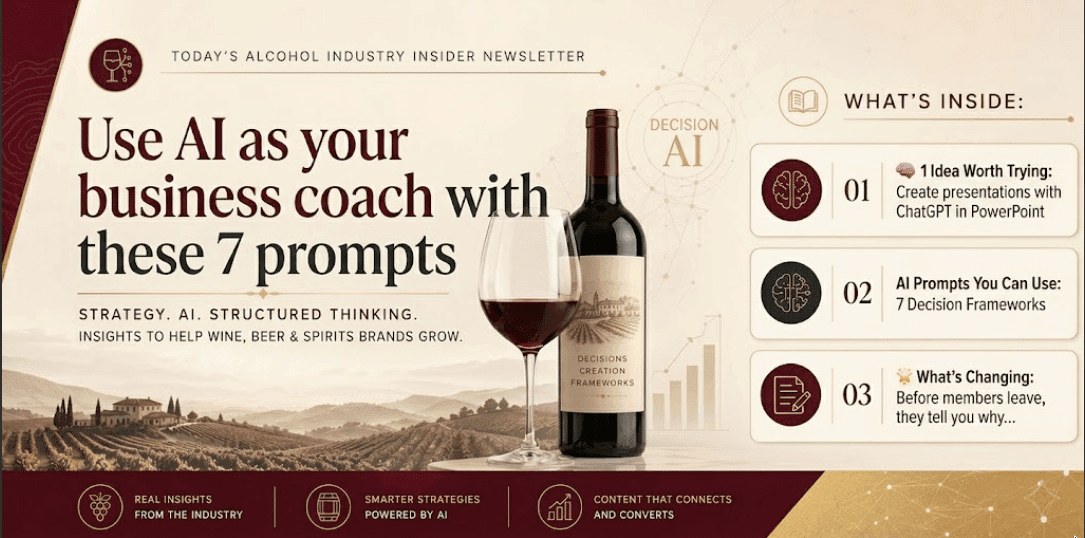
Today’s Alcohol Industry Insider Newsletter
What’s inside:
🧠 1 Idea Worth Trying: Create presentations with ChatGPT in PowerPoint
💡 AI Prompts You Can Use: 7 Decision Frameworks from Masters of Business
🌟 What’s Changing: Before members leave, they tell you why…

How to Create Presentations with ChatGPT Directly in PowerPoint
Download ChatGPT for PowerPoint
Open PowerPoint > ‘Add-ins’ in the Insert tab
Search ‘ChatGPT’ > ‘Add’ to open it in the sidebar
Click ‘Continue with ChatGPT’ > Login with your ChatGPT account
Upload your content (documents, PDFs, spreadsheets, notes, reports, images, or research files) and start prompting
Sample Prompt: “Turn this report into a clean 10-slide executive presentation with key takeaways, charts, and speaker notes.”
You can also use it to generate pitch decks, sales presentations, strategy slides, and meeting summaries
Ask for slide outlines, presentation structures, visual ideas, summaries, charts, or speaker notes, and it turns them into polished, presentation-ready slides for your next meeting.

7 Decision Frameworks Built for the Alcohol Industry
Most operators in wine, beer, and spirits make their biggest decisions the same way their predecessors did 30 years ago. Gut. Industry convention. Whatever the distributor's rep said over lunch. Whatever the consultant pitched last quarter.
That worked when the category was growing, and shelves were thin. It does not work now.
These seven frameworks force structured thinking on the calls that actually move the business: pricing, distribution, DTC, tasting room investment, new SKUs, brand extensions, partnerships, and exits. They work on paper. They work better when you run them through Claude (or any capable AI) and let it push back on your assumptions.
Here are all seven, written for our industry, ready to use.
Copy and paste the prompt and change anything mentioned in [ ] to your particular issue.
---
Framework 1. First Principles Thinking
What it is: Tear the problem down to what is undeniably, physically, and economically true. Then rebuild the answer from those bricks instead of borrowing the answer from the winery, brewery, or brand down the road.
Why it matters in our industry: "Three-tier is the only way." "Wine clubs require a tasting room." "You need a distributor in every state." "Premium spirits need a celebrity." Most of these are not rules - they are habits. First Principles separates the two.
The prompt:
> "I'm working through a problem in the [alcohol beverage industry] and I want you to think it through with me using First Principles. Do not give me advice based on what other [wineries, breweries, or brands] typically do. Strip my problem down to its fundamental truths: the things that are physically, legally, or economically undeniable. Then rebuild a solution from there. Challenge every assumption I make. If I say something is 'how the industry works,' make me prove it. Call out anything I'm taking for granted. My problem: [DESCRIBE YOUR PROBLEM IN DETAIL]"
---
Framework 2. Inversion
What it is: Charlie Munger's tool. Stop asking how to win. Start asking how to guarantee a loss. Then refuse to do any of those things.
Why it matters in our industry: Most brand decks lead with growth. Very few lead with a serious inventory of how the brand could die. Distributor abandonment. Tasting room reviews tanking on Yelp. A wine club that bleeds members faster than it adds them. A new SKU that cannibalizes the flagship. Inversion forces all of that onto the table before you spend the money.
The prompt:
> "I want you to help me solve a problem using Inversion, the mental model from Charlie Munger. Instead of asking 'How do I make this succeed?' I want you to start with 'How would I guarantee this fails?' List every realistic way this initiative could die in the alcohol beverage industry: distribution mistakes, pricing mistakes, brand positioning errors, operational failures, compliance issues, team failures, market timing. Be specific to [wine, beer, or spirits] as appropriate. Then flip each failure mode into a concrete preventive action I can take. My goal: [DESCRIBE WHAT YOU'RE TRYING TO ACHIEVE]"
---
Framework 3. The 5 Whys
What it is: Toyota's diagnostic tool. Ask "why" five times in a row. The first answer is almost always the symptom. The fifth is usually the cause.
Why it matters in our industry: Tasting room traffic is down. Why? Fewer reservations. Why? Lower conversion from the website. Why? The booking flow is buried. Why? It was built three years ago and never revisited. Why? Nobody owns the website. There it is. The real problem is not traffic. It is ownership.
The prompt:
> "I have a recurring problem in my [alcohol beverage business] and I need the actual root cause, not the surface symptom. Use the 5 Whys method from the Toyota Production System. Start with the problem I describe. Ask 'Why does this happen?' Take my answer and ask 'Why?' again. Repeat at least five times, going deeper each round, until we reach something structural I can actually fix (a process, a person, a system, an incentive, a piece of tech). Do not accept vague answers from me like 'the market is soft' or 'consumers are pulling back.' Push me to be specific at every level. My recurring problem: [DESCRIBE THE PROBLEM YOU KEEP RUNNING INTO]"
---
Framework 4. Second-Order Thinking
What it is: Howard Marks's separator between average investors and great ones. The first-order effect of a decision is what happens immediately. The second is what that effect triggers. The third is what shows up six to twelve months later.
Why it matters in our industry: Raise wine club prices 15%. First order: revenue per member jumps. Second order: a slug of members cancel in protest. Third order: your loudest cancellations post about it, your average tenure drops, and your acquisition cost no longer pencils. The first-order math looked great. The third-order math is a different story. The same logic applies to distributor changes, capacity expansion, pack size changes, and new market entries.
The prompt:
> "I'm about to make a decision in my [alcohol beverage business] and I want to think it through using Second-Order Thinking, as Howard Marks describes it. Map the consequences in three layers:
> - First order: what happens immediately
> - Second order: what that triggers next
> - Third order: what that causes 6 to 12 months from now
> Do this for both paths: 'I do it' and 'I don't do it.' Be specific to the [alcohol industry]. Account for distributor reactions, trade response, on-premise vs off-premise dynamics, consumer perception, and team morale where relevant. Be brutally honest about the downstream effects. My decision: [DESCRIBE THE DECISION YOU'RE FACING]"
---
Framework 5. Regret Minimization
What it is: The framework Jeff Bezos used when he decided to walk away from Wall Street and start Amazon. Fast forward to age 80. Look back at this decision. Which version of the choice haunts you?
Why it matters in our industry: Should I sell the winery to a holding company? Should I leave my distributor sales job to launch my own brand? Should I take on outside investment? Should I close the second tasting room? These calls are too emotional for spreadsheets. They need clarity, not optimization.
The prompt:
> "I'm stuck on a major decision in my [alcohol beverage career or business]. Help me work through it using Jeff Bezos's Regret Minimization Framework. Put me at age 80 looking back at this exact moment. From there, help me think through:
> - Which choice would I regret NOT taking?
> - Which risks would feel trivial in hindsight?
> - Which 'safe' option would haunt me for the rest of my life?
> Do not let me hide behind logic or spreadsheets. This is about emotional clarity. Push me to be honest about what I actually want from this industry and this career. My decision: [DESCRIBE THE FORK IN THE ROAD YOU'RE FACING]"
---
Framework 6. Opportunity Cost Analysis
What it is: Every yes is a no to something else. This framework drags the invisible "something else" into the light so you can see what you are actually giving up.
Why it matters in our industry: Sign with the new distributor in three states? That is time and attention you are not putting into DTC. Launch the rosé line? That is shelf space and brand attention you are taking from the Cabernet. Open the second tasting room? That is capital and labor you are not pouring into the wine club. None of these are wrong decisions. But none of them are free.
The prompt:
> "I want to evaluate a commitment in my [alcohol beverage business] using Opportunity Cost Analysis. Every time I say yes to one thing, I am saying no to everything else I could do with the same time, money, and team capacity. Help me see those tradeoffs clearly. For the commitment I describe, answer:
> - What specifically am I giving up by doing this?
> - What is the highest-value alternative use of the same resources (capital, time, distributor attention, tasting room labor, marketing budget)?
> - If I could only pick one, which option builds more long-term equity value in the business?
> Frame this as a 'this versus that' decision, not yes or no. What I'm considering: [DESCRIBE THE OPPORTUNITY OR COMMITMENT]"
---
Framework 7. Pre-Mortem Analysis
What it is: Psychologist Gary Klein's gift to anyone planning a launch. Fast forward six months. The project failed. Now work backward and list every reason why.
Why it matters in our industry: Vintage releases, new brand launches, label redesigns, market expansions, tasting room buildouts, and acquisitions all share one thing: optimistic launch decks. A Pre-Mortem flips the deck upside down before you spend the money. The distributor never picks it up. The label tests poorly with on-premise buyers. The new market sees a regulatory change. Your head winemaker leaves. The capacity expansion comes online in a soft market. Better to find these out now than at the wrap-up meeting.
The prompt:
> "I'm about to launch something in my [alcohol beverage business] and I want you to run a Pre-Mortem Analysis using Gary Klein's method. Here is how it works: it is 6 months from now and this project has failed completely. Dead. Work backwards and tell me every plausible reason it died. Be industry-specific: distribution, compliance, trade response, consumer reception, pricing, packaging, team execution, timing, supply chain, weather/vintage, competitive response. Do not give me generic risks like 'poor execution.' Give me scenario-level detail. What went wrong, when in the timeline, and why I did not see it coming. Then, for each failure scenario, give me one preventive action I can take right now, before launch. My project: [DESCRIBE YOUR UPCOMING PROJECT OR LAUNCH]"
---
## The Quick Reference Card
Print this. Tape it to your monitor. Use it when the room is leaning toward the obvious answer.
1. First Principles. Strip the problem to bedrock truths and rebuild. Stop borrowing answers from operators who had different problems.
2. Inversion. List every way to fail, then refuse to do any of it. Munger built a fortune on this.
3. 5 Whys. Ask why five times in a row. Fix the structural cause, not the symptom.
4. Second-Order Thinking. Three layers of consequences, on both the yes and no paths, before you commit.
5. Regret Minimization. Put yourself at 80. Pick the version of you that sleeps better.
6. Opportunity Cost. Every yes is a no. Make the no visible before you sign.
7. Pre-Mortem. Assume the launch died. List the cause of death. Fix it now.
---
Forward this to the operator on your team who needs it most. Better calls start with better questions.

Before Members Leave, They Usually Tell You They're Leaving
Wine club cancellations rarely happen overnight. Most members give off warning signs weeks or even months before they leave, but many wineries don't have systems in place to spot those signals until it's too late. The good news is that improving retention often delivers a far greater return on investment than constantly chasing new members.
By identifying at-risk customers early and taking proactive action, wineries can reduce churn, strengthen loyalty, and increase the lifetime value of every club member. Here are five practical ways to identify potential cancellations before they happen and create opportunities to keep more members engaged.
1. Monitor Key Behavioral "Warning Signs"
Members rarely cancel without dropping hints first. Over the months leading up to a formal cancellation, their engagement typically tapers off.
How to Detect It: Track members who start skipping scheduled shipments, ignore invitations to winery events, or register customer complaints about their recent orders.
What to Do: Flag these accounts in your CRM. Reach out with personalized communications, offer an option to temporarily pause instead of cancel, or check in directly to resolve any lingering customer service complaints.
2. Review Historical Transaction Behavior (Look-Back Analysis)
To know what future churn looks like, you have to look at past departures.
How to Detect It: Take a random sample of members who have already lapsed and analyze their transaction history from the 6 to 12 months before they officially quit. Identify the exact patterns they shared. Do this by uploading the data into your favorite LLM and ask for patterns. Try Claude Cowork localized on your desktop for great results.
What to Do: Use those discovered patterns to build an internal "at-risk" list. Cross-reference your active member database against these specific behaviors so you can intervene before the pattern repeats itself.
3. Analyze the Lifecycle and Acquisition Context
When and how a member joins heavily dictates how long they stay.
How to Detect It: Segment your churn data by age, join date, and how they signed up (e.g., a high-pressure tasting room signing versus a customer who joined online after multiple organic purchases).
What to Do: Tailor your post-signup onboarding. For instance, peer-pressured tasting room signups might need extra attention and high-value touchpoints during their first few months to solidify their connection to the brand.
4. Watch the 3 Critical Churn Milestones
Churn is heavily driven by predictable lifecycle events. If you only track three things, track these:
How to Detect It: Keep a strict eye on members reaching these specific milestones:
Immediately after the first shipment (when they evaluate the initial value).
At the formal renewal time.
During involuntary events (failed credit cards, expired payment details).
What to Do: Implement automated yet warm email flows for credit card updates. For first-time shipees, follow up with digital content (like tasting notes or video links) to maximize the unboxing experience and cement the club's value.
5. Build and Map a "Retention Curve"
You can't fix a leak if you don't know where the hole is. A retention curve shows you exactly what percentage of members remain at specific intervals (e.g., 6 months, 12 months, 24 months) after signing up.
How to Detect It: Pull your signup and cancellation data from the past 3 to 5 years. Group the data into 6-month intervals to find your steepest drop-off point (which for most wineries is within Year 1).
What to Do: Deploy targeted retention campaigns exactly when the curve dips. If your curve shows a major drop at month 6, preemptively launch exclusive benefits at month 5, such as hosting complimentary new-member events, sending wine pairing tips, or offering preview samples of upcoming shipments to build anticipation.
From the Editor:
I am always open to consulting, implementation, or brainstorming sessions. Just respond to this email, and I will get back to you shortly.
Alcohol Industry Insider Newsletter - The twice-a-week growth newsletter for wine, beer, and spirits businesses that need smarter marketing, better sales, practical AI tools, and clear ideas they can implement now.
By Jeremy Young - serial entrepreneur, growth marketer, wine critic, and beverage industry insider.
Respond to this email with questions, ideas, or opportunities, and I will get back to you shortly!
Until next time,
— Jeremy
Share This Newsletter
If you found this content useful, please share it with your colleagues and friends…
👉 www.alcoholindustryinsider.com
Get the next one in your inbox.
Free, mondays, wednesdays, and fridays. Five minutes to read.
Work with Jeremy
Reading the plays is the easy part.
Changing what your team does on Monday morning is harder. Book a 30-minute strategy session with me, and we'll work out what to change first and how we could work together.
30 minutes on Google Meet