35 Points Apart in the Same Market
The latest SVB Wine Report and What to Actions to Take
 Jeremy Young5 min read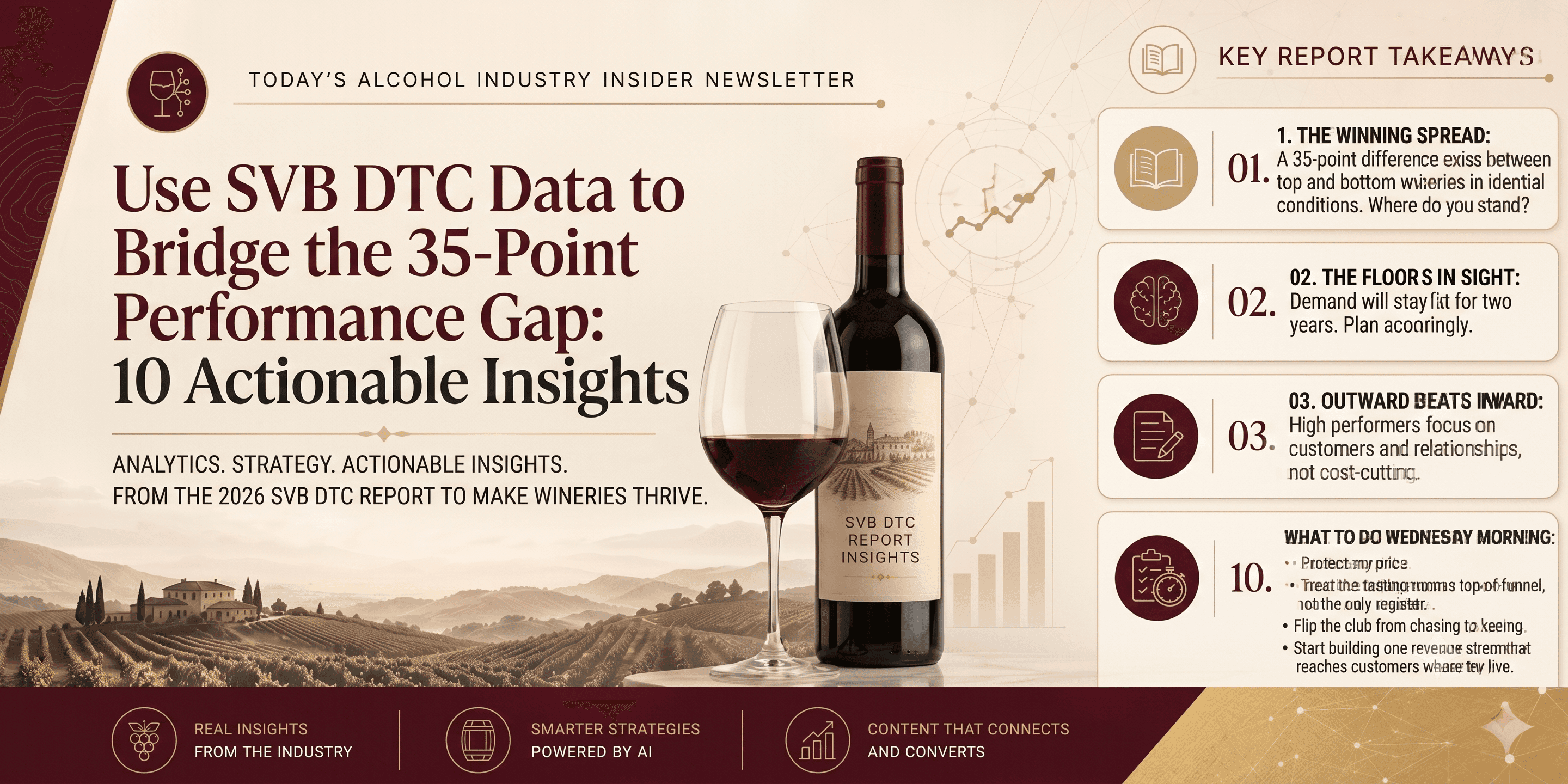
Today’s Alcohol Industry Insider Newsletter
What’s inside:
🌟 What’s Changing and What to Do About It: Highlights of the SVB Wine Report

SVB dropped its 2026 Direct-to-Consumer report last week. 450 wineries, all 2025 data.
If you only keep one number from it, keep this one. The top quartile grew revenue 22%. The bottom quartile lost 13%. Same market, same headwinds, same year.
The median winery grew zero. So in identical conditions, the distance between the wineries pulling ahead and the ones falling behind is about 35 points. And it's getting wider by the month.
That spread is the whole story this year. The downturn is old news. How far apart the winners and losers have pulled in the same weather, that's new.
Here's what's actually driving it, and what I'd do about each one.
1. We're near the bottom. That's not the same as the bottom being over.
SVB thinks the steepest part of the drop is behind us. Sales are still falling, the rate of decline is just slowing. They're calling zero growth somewhere in 2027 or 2028.
So the floor is in sight. The ceiling isn't. Build your next two years around demand staying flat, because it probably will.
2. Outward beats inward, every single time.
The most notable discovery in the report is also the most straightforward: external focus consistently outperforms internal preoccupation.
High performers spend their energy on customers and relationships. Low performers spend it on cutting costs and fixing operations. Both groups run the same tactics: events, pricing moves, club tweaks, and tasting room upgrades. The winners just aim them outward.
Efficiency is the price of staying in the game. It's not a strategy, and it has never once made anybody want to buy a bottle of wine. If your last few strategy meetings were mostly about trimming expenses, you're running the losing playbook.
3. Cutting your bottle price tells your best buyers the bloom is off the rose.
Low performers are twice as likely to lead with discounts. High performers are 60% more likely to raise prices.
Discounting trains your most loyal customers to wait for the next markdown. Across a portfolio, it quietly drains your brand equity, and luxury buyers read it instantly. If you genuinely need to move wine, discount the shipping, bundle a few bottles, or drop a surprise bottle into a case order.
4. Tasting room traffic is down about 2 to 3% a year, and it's not bouncing.
Reservations have fallen every month on a trailing basis. Every region, every winery size, top to bottom. The model that runs on a steady stream of new faces is now running on less.
Repainting the patio won't fix this. Low performers are 2.3x more likely to bet on "tasting room changes" as their main move, and the data says it isn't working.
5. Average order value is carrying the channel. Don't ask it to carry forever.
Dollar sales are holding up better than case sales, because the people who do show up are spending more. Napa's average order hit $454. Sonoma $267. The overall sat around $152.
Handy right now. But there's a hard limit to how long rising spend-per-guest can paper over falling traffic, and you will eventually find it. Push conversion and spend-per-guest, and stop pretending the door count doesn't matter.
6. Cutting tasting fees is a coin flip at the moment.
15.5% of wineries lowered their fees last year, double the year before. Only about a quarter saw better visitation. Almost half saw nothing, or said it was too early to tell.
A fee cut on its own does nothing. Decide who you're trying to pull through the door first, then price for that person. A cheaper tasting with no plan behind it just leaves money on the bar.
7. The wine club stopped being a growth engine.
Net club growth fell from 13% in 2021 to roughly 2% now. New signups are basically canceling out the cancellations.
Your older, high-tenure members are aging out, and the younger ones replacing them don't stick around as long. The club is a retention game now. Lifetime value sits around $2,400, and average tenure is around 34 months, and both numbers quietly erode the second you stop engaging people. Be present.
8. Talk to your members when there's no box to sell them.
The clearest club fix in the whole report: high performers engage members outside the shipment cycle. They segment their list, they build real relationships with fewer people, and they show up personally between credit card charges.
If the only time your club hears from you is when their card gets billed, there's your attrition problem, right there in one sentence.
9. The growth is outside the four walls of your tasting room.
This is SVB's "find next" idea, and I think it's the most important thing in the report.
Internet sales are stuck at 6% of revenue and actually slid below pre-COVID levels. That's a wide-open lane sitting right in front of you. The wineries getting ahead are taking the brand to the customer: traveling club events in the cities where their members actually live, virtual tastings, shipped tasting kits, private member dinners, and corporate partnerships.
You don't need all of them. Pick one or two. Build it into a real second revenue stream that doesn't depend on someone driving up your road.
10. Nobody has cracked the new model yet. That's your opening.
The winning plays are still messy and unproven. There's no clear path anybody can hand you.
Which is exactly why the edge right now goes to whoever experiments fastest and kills the dead ends quickest. Protect your pricing and your brand while you test, watch the ROI, and move. The wineries getting ahead are simply the ones willing to try something before it feels safe.
What I'd do Wednesday morning
If I owned a winery this week, four things.
- Protect my price.
- Treat the tasting room as the top of my funnel instead of my only register.
- Flip the club from chasing new members to keeping the ones I've got.
- And start building one revenue stream that reaches customers where they live.
Same market, 35 points of difference. All of it comes down to what these owners chose to do about it. Which, if you're willing to act, is the most encouraging thing in the whole report.
From the Editor:
I am always open to consulting, implementation, or brainstorming sessions. Just respond to this email, and I will get back to you shortly.
Alcohol Industry Insider Newsletter - The twice-a-week growth newsletter for wine, beer, and spirits businesses that need smarter marketing, better sales, practical AI tools, and clear ideas they can implement now.
By Jeremy Young - serial entrepreneur, growth marketer, wine critic, and beverage industry insider.
Respond to this email with questions, ideas, or opportunities, and I will get back to you shortly!
Until next time,
— Jeremy
Share This Newsletter
If you found this content useful, please share it with your colleagues and friends…
👉 www.alcoholindustryinsider.com
Get the next one in your inbox.
Free, mondays, wednesdays, and fridays. Five minutes to read.